

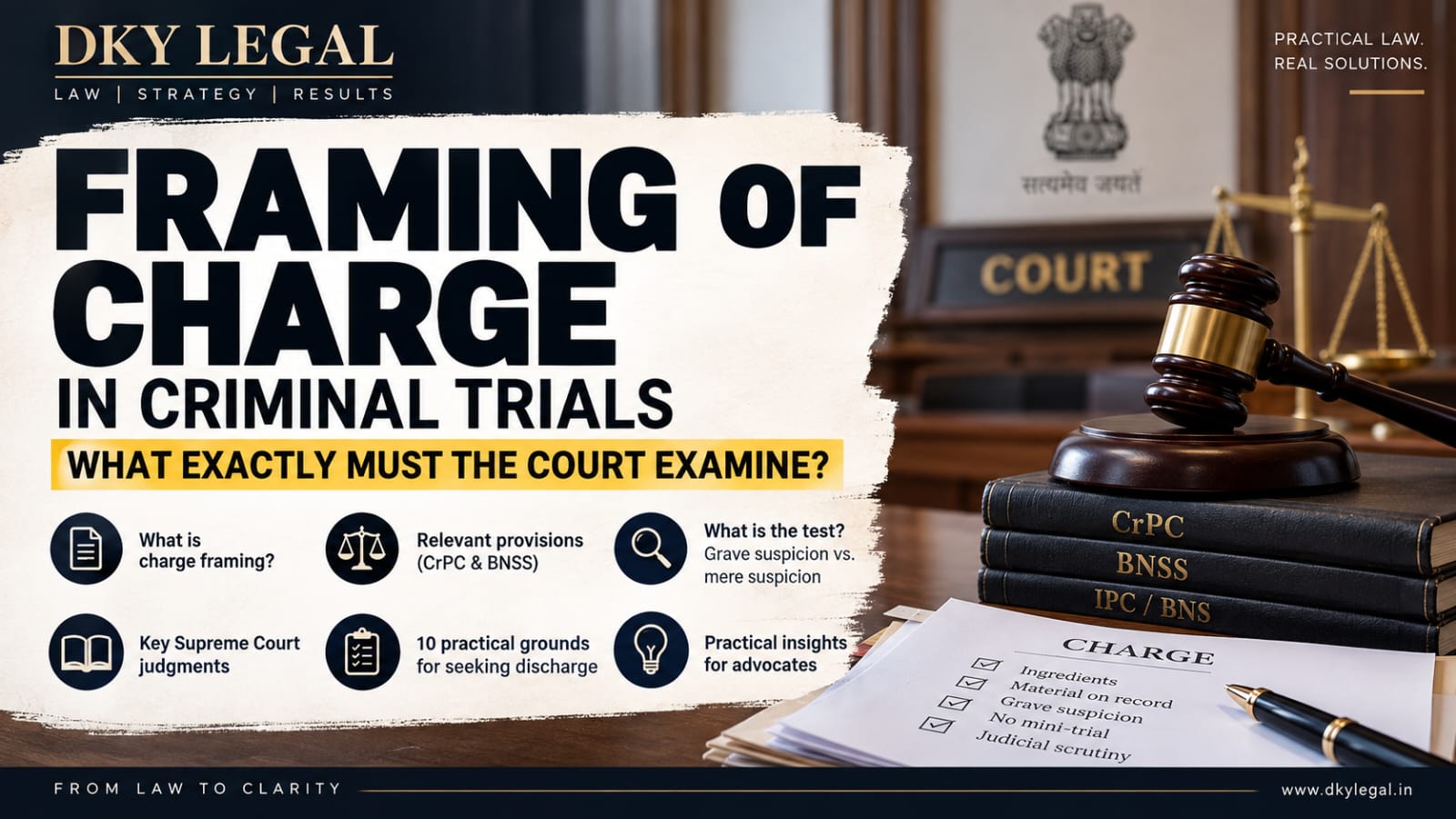
What Exactly Must the Court Examine?
By DKY Legal | Advocates & Legal Consultants, Tis Hazari Courts, Delhi
Framing of charge is one of the most important stages of a criminal trial. It is the point at which the Court decides whether the material collected against an accused is sufficient to require him or her to face trial for a particular offence.
The Court is not deciding whether the accused is guilty. Nor is the prosecution required to prove its case beyond reasonable doubt at this stage. At the same time, framing of charge is not intended to be a mechanical exercise merely because a police report or complaint alleges that an offence has been committed.
The real question is whether the material before the Court, taken at its face value, provides sufficient ground for proceeding and raises the legally required degree of suspicion that the accused has committed the particular offence alleged.
This distinction — between proof, prima facie material, grave suspicion and mere suspicion — lies at the heart of the law relating to framing of charge, whether one is arguing it under the old Code of Criminal Procedure, 1973 (“CrPC”) or the Bharatiya Nagarik Suraksha Sanhita, 2023 (“BNSS”).
1. What is a “Charge”?
A charge is, in substance, the formal accusation communicated by the Court to an accused specifying the offence for which the accused is required to face trial.
Its importance flows from a basic requirement of a fair criminal trial: an accused must know precisely what accusation he or she has to meet.
Under the BNSS, the general provisions relating to charges are contained in Sections 234 to 247 — the same numbering scheme carried forward, with only structural renumbering, from Chapter XVII of the CrPC. Section 234 BNSS requires, among other things, that every charge state the offence with which the accused is charged and mention the law and section of law alleged to have been violated.
Thus, a properly framed charge performs two important functions: first, it informs the accused of the precise accusation against him; second, it identifies the offence and consequently defines the scope within which the prosecution is required to establish its case at trial.
2. IPC/BNS and CrPC/BNSS: Understanding the Difference
A distinction must be made between substantive criminal law and criminal procedure.
The Indian Penal Code, 1860 (“IPC”), and now the Bharatiya Nyaya Sanhita, 2023 (“BNS”), primarily define criminal offences and prescribe punishments. The CrPC, and now the BNSS, prescribe the procedure through which criminal cases are investigated, tried and decided.
Therefore, technically, the procedure for framing of charge is found in the CrPC/BNSS — not in the IPC/BNS. However, the IPC or BNS remains extremely important at the charge stage, because the Court must examine the ingredients of the substantive offence alleged against the accused. If an accused is proposed to be charged for cheating, the Court cannot merely ask whether the allegations appear suspicious — it must examine whether the prosecution material, taken at face value, discloses the essential ingredients of that particular offence. The procedural provisions and the substantive offence must always be read together at the stage of charge.
3. Relevant Provisions under the CrPC and BNSS
The applicable provision depends upon the nature of the criminal trial.
A. Cases Triable by a Court of Session
| CrPC, 1973 | BNSS, 2023 |
| Section 227 — Discharge | Section 250 — Discharge |
| Section 228 — Framing of Charge | Section 251 — Framing of Charge |
Section 250(2) BNSS requires discharge where, after considering the record and documents and hearing both sides, the Judge considers that there is no sufficient ground for proceeding. Section 251 provides for framing of charge where there is ground for presuming that the accused has committed the relevant offence. The BNSS adds a discharge-application timeline of 60 days from the date of committal (Section 250(1)), and requires the charge to be framed in writing within 60 days from the first hearing on charge (Section 251(1)(b)).
B. Warrant Cases Instituted on a Police Report
| CrPC, 1973 | BNSS, 2023 |
| Section 239 — Discharge | Section 262 — Discharge |
| Section 240 — Framing of Charge | Section 263 — Framing of Charge |
Under Section 262 BNSS, the Magistrate considers the police report and accompanying documents and, after hearing the prosecution and accused, discharges the accused where the charge is groundless. Section 263 requires the Magistrate to frame a written charge where there is ground for presuming that the accused committed an offence which the Magistrate is competent to try. Both provisions carry their own 60-day timelines — from supply of documents under Section 230 for the discharge application, and from the first hearing on charge for framing.
C. Warrant Cases Instituted Otherwise than on a Police Report
| CrPC, 1973 | BNSS, 2023 |
| Section 245 — Discharge | Section 268 — Discharge |
| Section 246 — Framing of Charge | Section 269 — Procedure where accused is not discharged / framing of charge |
The position differs from a warrant case instituted on a police report because prosecution evidence is taken before the Court reaches the discharge/charge stage. Section 269 BNSS follows directly on Section 268: where the Magistrate finds the accused is not to be discharged, the charge is framed, read out, and the accused is asked to plead.
D. Summons Cases
| CrPC, 1973 | BNSS, 2023 |
| Section 251 — Substance of accusation to be stated | Section 274 — Substance of accusation to be stated |
Strictly speaking, a formal “charge” in the same manner as a warrant case is not framed in an ordinary summons case. Under Section 251 CrPC, and now Section 274 BNSS, only the particulars of the offence are stated to the accused, and no formal charge needs to be framed. Section 274 BNSS carries one genuinely new safeguard not found in the old Section 251 CrPC: if the Magistrate considers the accusation groundless, he must record reasons in writing and release the accused — and that release “shall have the effect of discharge.” This is a useful additional string for a defence advocate arguing a summons-triable matter under the BNSS regime.
4. Which Law Applies After the BNSS Came Into Force?
The BNSS came into force on 1 July 2024. That does not mean every criminal proceeding pending after that date automatically shifted from the CrPC to the BNSS.
Section 531 BNSS, the repeal and savings provision, is crucial. Broadly, where an appeal, application, trial, inquiry or investigation was already pending immediately before the commencement of the BNSS, Section 531 provides for its continuation under the CrPC as if the BNSS had not come into force. Before citing a provision relating to discharge or framing of charge, a practitioner should first determine which procedural regime governs the particular proceeding — and the Supreme Court has since confirmed (in a 2026 ruling) that in any event the substantive standard for discharge and framing of charge is unchanged across the two Codes; only the timelines are new.
5. What Test Does the Court Apply While Framing Charge?
This is the central question. The Court does not ask “has the prosecution proved that the accused is guilty beyond reasonable doubt?” – that is the test applicable at the conclusion of the trial.
At the charge stage, under Sections 227/228 CrPC (Sections 250/251 BNSS) for Sessions trials, or the corresponding warrant/summons provisions above, the Court broadly asks: if the prosecution material is taken at its face value, does it disclose the ingredients of the alleged offence and raise a strong or grave suspicion that the accused has committed that offence?
The expression “ground for presuming” does not amount to a final legal presumption of guilt. It is a tentative judicial assessment for deciding whether the accused should be put to trial.
6. Strong/Grave Suspicion Versus Mere Suspicion
The distinction between grave suspicion and mere suspicion is fundamental. The prosecution is not required to establish guilt at the charge stage — strong suspicion based on the material may be sufficient. But mere conjecture, speculation or suspicion unconnected with the essential ingredients of the offence cannot substitute the statutory requirement.
A useful way of understanding the spectrum:
- No material / charge groundless → Discharge
- Mere suspicion, but not grave suspicion → Discharge may follow
- Strong or grave suspicion based on prosecution material → Charge may be framed
- Proof beyond reasonable doubt → Required only for conviction, not framing of charge
7. The Court Is Not a Mere “Post Office”
It is sometimes incorrectly assumed that because the threshold at the charge stage is comparatively low, the Court must accept whatever sections the investigating agency has mentioned. That is not the law. The Court has an independent judicial duty to examine the material, and may sift and weigh it to a limited extent to determine whether a prima facie case or the requisite grave suspicion exists — under Section 227/228 CrPC or Section 250/251 BNSS alike. The Court cannot act as a mouthpiece of the prosecution, but equally this power cannot become a full-fledged appreciation of evidence.
8. No “Mini-Trial” at the Stage of Charge
The Court cannot conduct a mini-trial while deciding whether to frame charge. Questions such as which witness is ultimately believable, whether a witness will withstand cross-examination, or whether the prosecution will secure conviction, are matters for trial. The Court can examine whether the necessary ingredients exist on the prosecution’s own material; it ordinarily cannot decide whether the evidence proving those ingredients should ultimately be believed.
9. Ingredients of the Offence Must Still Exist
A lower threshold of proof does not mean the ingredients of the offence can be ignored. Strong material showing an accused participated in one act does not automatically justify framing a charge for a different offence requiring a wholly different intention, knowledge or factual ingredient. The Court must undertake an offence-wise and accused-wise examination: even if the prosecution case is accepted at its highest, do the facts attributed to this particular accused disclose the ingredients of this particular offence? An essential ingredient completely absent from the prosecution material cannot ordinarily be cured by leaving it for trial.
10. Can the Court Examine Contradictions at the Charge Stage?
Minor contradictions and inconsistencies ordinarily belong to the domain of trial. There is a difference between a contradiction requiring appreciation of evidence and a fundamental absence of an ingredient of the offence. Rather than arguing “the complainant is lying,” a legally stronger formulation is often: “even if the complainant’s statement is accepted as correct in its entirety, the essential ingredient of the offence sought to be charged is absent.” That keeps the argument within the permissible scope of a charge hearing.
11. Can the Accused Produce Defence Evidence at the Stage of Charge?
Ordinarily, no. The Supreme Court in State of Orissa v. Debendra Nath Padhi, (2005) 1 SCC 568, held, in the context of Sections 227/228 CrPC (now Sections 250/251 BNSS), that the “record of the case” refers to the material submitted by the prosecution. The accused does not ordinarily have a right to introduce defence material at this stage merely to demonstrate innocence — that opportunity arises at the appropriate stage of trial. A discharge application should normally be built around deficiencies in the prosecution’s own case, not an alternative defence narrative.
12. Landmark Supreme Court Judgments
State of Bihar v. Ramesh Singh, (1977) 4 SCC 39
One of the foundational authorities under Section 227/228 CrPC (Section 250/251 BNSS). The Court is not required at the charge stage to determine whether conviction is certain; if the prosecution material creates a strong suspicion leading the Court to think there is ground for presuming the accused committed the offence, framing of charge is justified. The judgment also holds the converse: if the prosecution evidence, even fully accepted before cross-examination or rebuttal, cannot show the accused committed the offence, there is no sufficient ground for proceeding.
Crux: Strong suspicion may justify charge; proof sufficient for conviction is unnecessary.
Union of India v. Prafulla Kumar Samal, (1979) 3 SCC 4
One of the most important judgments on discharge under Section 227 CrPC (Section 250 BNSS). The Judge has the power to sift and weigh evidence for the limited purpose of determining whether a prima facie case exists; where the material discloses grave suspicion, charge may be framed; where two views are equally possible and the material gives rise to mere suspicion, the Judge may discharge the accused; and the Judge cannot act merely as a “Post Office or a mouthpiece of the prosecution.” The Court may consider broad probabilities, total effect of the material and basic infirmities, without a roving inquiry into the merits.
Crux: The Court must apply judicial mind. Grave suspicion is enough; mere suspicion is not.
Sajjan Kumar v. CBI, (2010) 9 SCC 368
Comprehensively restated the Section 227/228 CrPC principles, equally applicable to Section 250/251 BNSS. The Judge may sift the evidence for the limited purpose of deciding whether a prima facie case exists; grave suspicion which remains unexplained justifies charge; but the Court cannot undertake a roving inquiry as if conducting the trial itself.
Crux: Limited sifting is permissible; a mini-trial is not.
State of Orissa v. Debendra Nath Padhi, (2005) 1 SCC 568
Clarified the material the Court may consider under Section 227 CrPC (Section 250 BNSS). The accused ordinarily cannot rely on independent defence material and demand its evaluation at the charge stage; the inquiry is principally based on the record and documents forming part of the prosecution case.
Crux: Discharge ordinarily has to emerge from the prosecution record itself, not from defence evidence.
Amit Kapoor v. Ramesh Chander, (2012) 9 SCC 460
Explains “ground for presuming” under Section 227/228 CrPC (Section 250/251 BNSS), and the correspondingly limited scope for revisional/quashing interference (Section 397/482 CrPC — now Section 442/528 BNSS) with an order framing charge. The Court is concerned with the existence of facts and ingredients constituting the offence, not with reaching a conclusion of certain guilt; the satisfaction at charge stage is tentative, not a final adjudication.
Crux: Existence of the constituents of the offence is fundamental; certainty of guilt is not required.
13. A Practical Five-Step Test for Charge Hearings
- What is the exact offence proposed against the accused? Begin with the statutory provision, not the factual narrative.
- What are the essential ingredients of that offence? Break it into its constituent elements — act, intention, knowledge, consequence, any special requirement.
- What prosecution material supports each ingredient? FIR/complaint, witness statements, medical evidence, documents, electronic material, recoveries.
- Does that material, taken at face value, raise grave/strong suspicion regarding that particular offence against that particular accused? This is where mere presence in the case is distinguished from legally sufficient material.
- Is the defence asking the Court to identify a missing ingredient, or to decide disputed evidence? The former is a legitimate charge-stage argument under Section 227/228 CrPC or Section 250/251 BNSS; the latter risks inviting a mini-trial.
14. Framing of Charge Is Not a Finding of Guilt
An order framing charge should never be confused with a finding that the accused committed the offence. The presumption operating at this stage — whether under CrPC or BNSS — is limited to deciding whether the case should proceed to trial. The prosecution must still establish guilt at trial, and the accused retains the presumption of innocence. The mere possibility of eventual acquittal is not, by itself, a ground for discharge.
15. The Correct Balance
A criminal court should not prematurely evaluate evidence and terminate a legitimate prosecution merely because the defence can identify possible weaknesses. Equally, an accused should not be compelled to undergo a criminal trial where the prosecution’s own material, even accepted at face value, fails to disclose its essential ingredients. The correct approach — under the CrPC’s Sections 227/228, 239/240, 245/246 and 251, or their BNSS successors, Sections 250/251, 262/263, 268/269 and 274 — is neither mechanical framing of charge nor a premature trial of the evidence.
The Court must ask: does the prosecution material, taken at its face value, disclose the ingredients of the alleged offence and create the degree of strong or grave suspicion necessary to put this particular accused to trial for that particular offence? That remains the central inquiry.
KEY TAKEAWAY
The threshold for framing of charge is lower than the threshold for conviction, but it is not meaningless. The Court does not determine guilt, does not ordinarily test witness credibility, and does not conduct a mini-trial. Yet it must apply judicial mind, identify the ingredients of the offence, examine the prosecution material, and determine whether it raises the requisite strong or grave suspicion — a standard that has carried forward unchanged from the CrPC into the BNSS, with only new statutory timelines layered on top. As the Supreme Court’s jurisprudence demonstrates, strong suspicion can justify a trial — but suspicion cannot manufacture an ingredient of an offence which the prosecution material itself does not disclose.
DKY LEGAL
Advocates & Legal Consultants, Delhi