

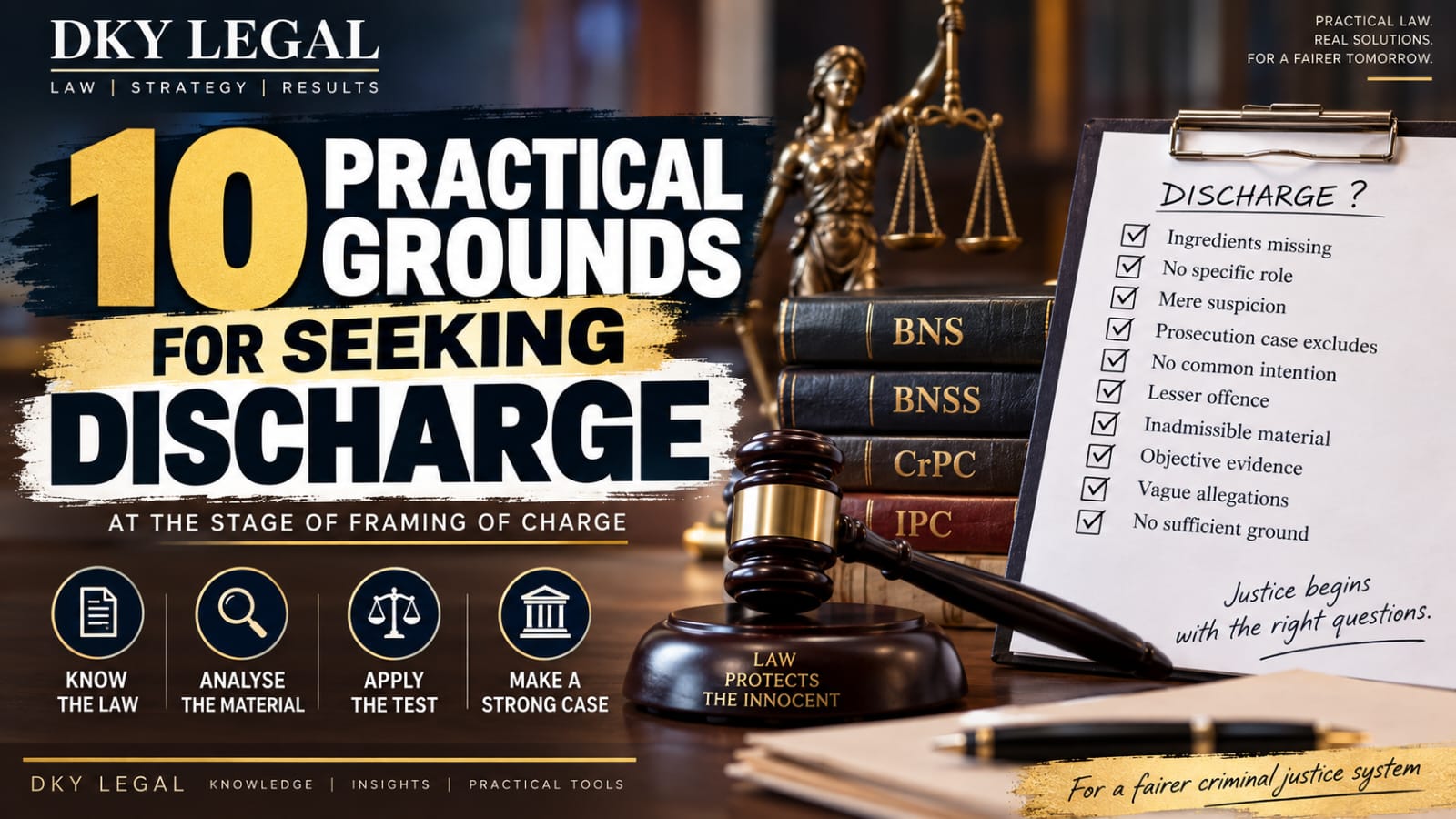
A Working Checklist for Building the Discharge Application
By DKY Legal | Advocates & Legal Consultants, Tis Hazari Courts, Delhi
A discharge application should ordinarily not read like final arguments after trial. The strongest discharge grounds are those which arise from the prosecution’s own material and demonstrate that, even if that material is accepted at face value, the legal threshold for framing the particular charge is not satisfied.
The following are ten practical grounds that commonly require examination:
Ground 1 Essential Ingredient of the Offence Is Missing
This is often the strongest ground for discharge.
Every criminal offence consists of specific statutory ingredients. The Court should first identify those ingredients and then ask whether the prosecution material contains facts capable of satisfying each of them.
For instance, where an offence requires a particular intention, knowledge, dishonest inducement, entrustment, threat, possession or other specific element, the mere existence of a dispute or allegation may not be sufficient if that essential ingredient is absent.
The argument should ideally be:
“Even if the entire prosecution case is accepted as correct, ingredient ‘X’ of the alleged offence is not disclosed.”
This avoids inviting the Court to conduct a mini-trial.
Ground 2 No Specific Role Is Attributed to the Accused
In cases involving several accused, the prosecution may sometimes make a detailed allegation against one person and thereafter collectively implicate others.
The Court should examine the material accused-wise.
The mere fact that an accused is a relative, employee, director, associate, family member or was present at some stage does not automatically establish participation in every alleged offence.
Where the prosecution material contains only omnibus allegations and fails to identify the particular act, participation or legally relevant role of an accused, this can become an important discharge consideration.
Ground 3 Material Creates Only Mere Suspicion, Not Grave or Strong Suspicion
The prosecution is not required to prove guilt beyond reasonable doubt at the charge stage. Nevertheless, there must be more than conjecture or a speculative possibility.
The distinction recognised by the Supreme Court is between mere suspicion and grave or strong suspicion founded upon material.
Where the material only suggests that the accused might somehow be connected with the occurrence, without sufficient factual material linking the accused with the commission of the alleged offence, the defence may contend that the threshold for framing charge has not been crossed.
Ground 4 Prosecution’s Own Case Excludes the Accused from the Offence
This is different from asking the Court to accept the defence version.
Sometimes the FIR, witness statements, CCTV footage, documents, call records or other prosecution material itself establishes a sequence which does not attribute the alleged act to the accused.
In such a case, the accused need not prove an alternative story.
The argument can be confined entirely to the prosecution record:
“On the prosecution’s own version, the act constituting this offence is attributed elsewhere and not to this accused.”
This can be particularly significant in multi-accused cases.
Ground 5 Constructive or Vicarious Liability Has Been Invoked Without Foundational Facts
Criminal liability is ordinarily personal unless the statute or a recognised principle of constructive liability provides otherwise.
Where the prosecution invokes provisions such as common intention, common object, conspiracy, abetment or statutory vicarious liability, the Court should examine whether the prosecution material contains the foundational facts necessary to attract that principle.
For example, the mere presence of several persons at the same occurrence does not, by itself, answer the separate question whether they shared the common intention necessary for constructive liability.
The defence should therefore examine not merely whether some offence occurred, but why the prosecution says this particular accused is legally responsible for the act of another person.
Ground 6 Alleged Conduct, Even If Accepted, Constitutes a Different or Lesser Offence
Sometimes the prosecution facts may disclose criminal conduct, but not the particular aggravated or more serious offence mentioned in the charge-sheet.
This distinction is important.
An accused need not always seek an all-or-nothing discharge. The Court can be invited to examine whether the material satisfies the ingredients of the specific offence sought to be charged.
Thus, even where sufficient material exists to proceed for one offence, an accused may legitimately seek discharge from another offence whose additional or distinct ingredients are absent.
A charge hearing should therefore be section-specific rather than case-specific.
Ground 7 Prosecution Relies Upon Legally Inadmissible Material to Supply a Missing Ingredient
At the stage of charge, the Court considers the prosecution record, but the nature of the material relied upon remains relevant.
For example, an alleged confession made by an accused to a police officer cannot ordinarily be treated as substantive evidence merely to fill a fundamental gap in the prosecution case (Section 25, Indian Evidence Act, 1872 / Section 23, Bharatiya Sakshya Adhiniyam, 2023), subject of course to the statutory rules governing discovery and admissibility.
The practical question is:
If the legally unusable material is kept out of consideration for the purpose for which it is prohibited, does the remaining prosecution material still disclose the essential ingredients of the offence?
This argument should be used carefully. The charge hearing is not the stage for deciding every evidentiary objection that may arise during trial.
Ground 8 Documentary or Objective Prosecution Material Fundamentally Undermines the Allegation
Medical records, official documents, CCTV footage, electronic records, seizure documents or other objective material collected by the prosecution may sometimes be inconsistent with the very foundation of the offence alleged.
Not every inconsistency warrants discharge.
A minor discrepancy ordinarily remains a matter for trial. But where the prosecution’s own objective material removes a foundational fact necessary for the offence, the issue may legitimately arise at the charge stage.
The distinction is between:
- “Which evidence should the Court believe?” — ordinarily a trial question
- “Does the prosecution material disclose the legally necessary fact at all?” — potentially a charge-stage question
Ground 9 Allegations Are Omnibus, Vague or Legally Insufficient
Expressions such as “all accused threatened,” “all accused harassed,” “all accused cheated,” or “all accused conspired” do not automatically establish every offence against every person.
The Court must look beyond the label and examine the underlying factual allegation.
Where the statutory offence requires a particular act, intention, inducement, threat or participation, a purely general allegation may be insufficient if the prosecution material does not disclose the facts necessary to support it.
However, vagueness should not be argued in isolation. The stronger formulation is to connect it directly with the missing statutory ingredient.
Ground 10 Even Taking the Prosecution Case at Its Highest, There Is No Sufficient Ground to Proceed for the Particular Offence
This is ultimately the cumulative discharge test.
The defence can place the prosecution case at its highest rather than disputing every factual assertion and ask:
“Assume everything alleged by the prosecution to be true. Does it still make out this offence against this accused?”
If the answer is no, the argument does not depend upon cross-examination, defence evidence or an assessment of credibility.
This is often the most effective way to structure a discharge submission because it keeps the Court within the permissible boundaries of the charge stage.
Practical Drafting Tip
A discharge application should ideally be prepared as an ingredient-to-evidence matrix:
Offence Alleged → Essential Ingredient → Prosecution Material Relied Upon → Whether That Material Satisfies the Ingredient → Result
This approach prevents the application from becoming a lengthy factual denial. It also allows the Court to identify the precise legal issue immediately.
The objective at the stage of discharge is generally not to establish the innocence of the accused. It is to demonstrate that the prosecution material itself does not cross the legal threshold necessary to put the accused to trial for the particular offence.
What Usually Does Not Work at the Charge Stage
A discharge application becomes considerably weaker when it is based primarily upon minor contradictions, anticipated weaknesses in cross-examination, an alternative defence story, disputed questions of fact, or arguments about why a prosecution witness should ultimately not be believed.
Those issues ordinarily belong to trial.
The more effective question remains:
“Even if the prosecution is believed at this stage, where is the material satisfying each essential ingredient of the offence against this particular accused?”
DKY LEGAL
Advocates & Legal Consultants, Delhi