

When parents separate and the question of child maintenance lands in court, one argument surfaces with predictable regularity: the mother is earning too, so why should the father bear the full burden?
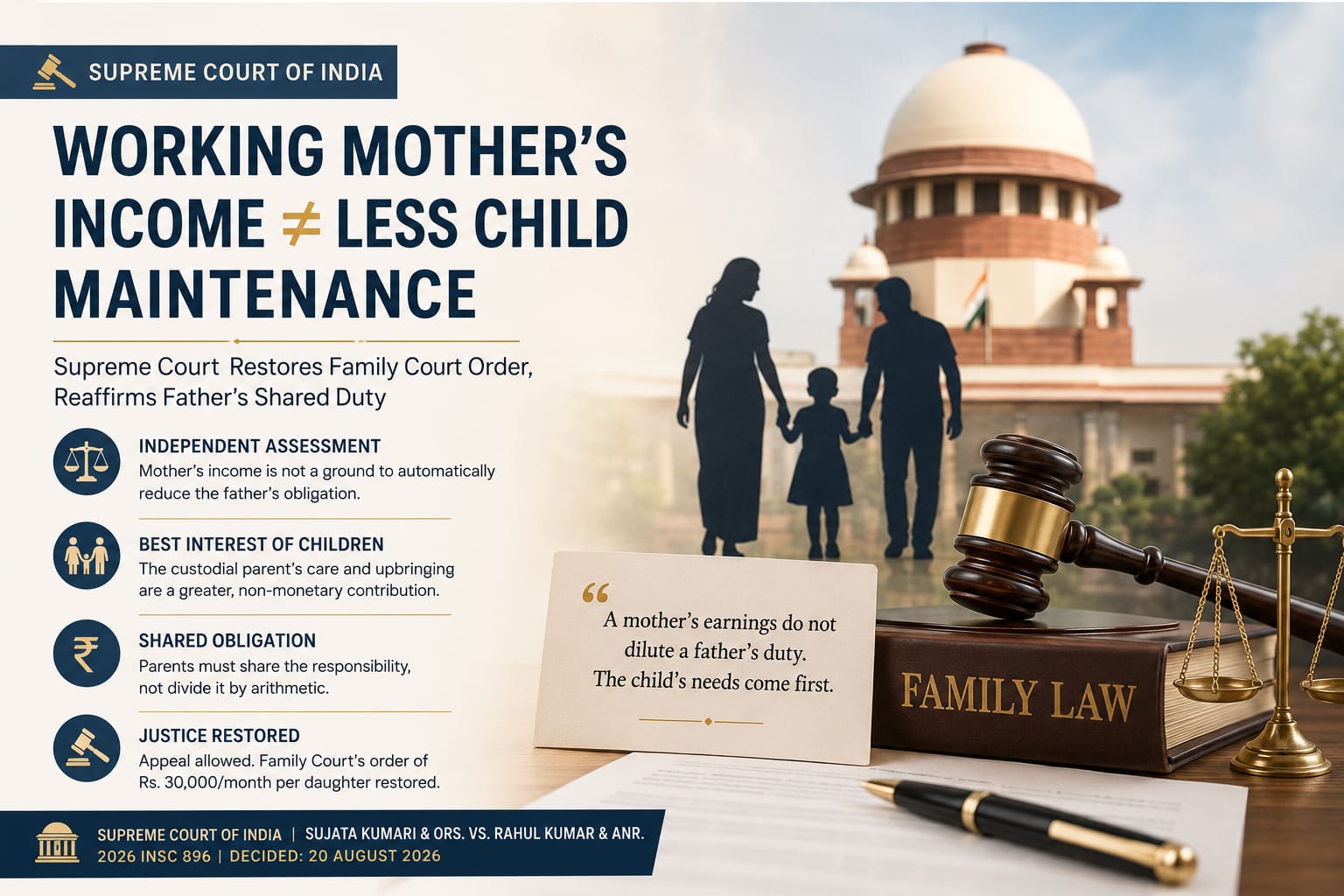
In a significant ruling delivered on 20th August 2026, the Supreme Court in Sujata Kumari & Ors. v. Rahul Kumar & Anr. (2026 INSC 896) firmly rejected the idea that a working mother’s income can be used to mechanically slash the father’s maintenance liability toward his children.
Background of the Case
The case involved two doctor-parents. The wife, an MBBS, DGO gynaecologist, earned Rs. 1,50,000 a month. The husband, an MBBS, MD paediatric consultant, claimed to earn Rs. 2,00,000 a month, though the wife alleged he in fact ran his own nursing home.
Their two daughters, aged about nine and eight, lived with their mother after the marriage broke down. In 2022, the family approached the Family Court under Section 125 CrPC seeking maintenance of Rs. 2,50,000 per month.
Family Court’s Decision
The Family Court took a balanced view. It declined interim maintenance to the wife herself, reasoning that a spouse already in gainful employment does not need protection against destitution, which is the real purpose of interim maintenance.
But for the two minor daughters, it awarded Rs. 30,000 per month each, Rs. 60,000 in total, after carefully going through their educational and other expenses.
Allahabad High Court Halves the Amount
The husband challenged this in revision before the Allahabad High Court, and here the story took an unfortunate turn.
The High Court did not find the Family Court’s assessment flawed. It did not hold that Rs. 60,000 a month was excessive for two school-going children of a man earning Rs. 2,00,000 a month. In fact, it accepted that figure as fair.
Yet it still cut the award in half, to Rs. 15,000 per daughter, simply because the mother was also earning and, in the Court’s view, the burden could not fall on the father alone.
Supreme Court Rejects Mechanical Reduction
The Supreme Court was not persuaded.
Justice Vikram Nath, writing for the Bench, pointed out that the High Court’s order gave no real reason for interference beyond this one fact. If the Family Court’s reasoning was sound and the amount was not excessive, there was nothing left to justify halving it.
The obligation to maintain children, the Court held, is indeed shared by both parents, but it “cannot be divided by arithmetic alone.”
A mother who earns and who also raises the children, manages their daily lives, and shoulders the invisible work of parenting is already contributing a great deal, often more than money can measure. That contribution cannot be treated as a discount coupon for the father’s liability.
The Court’s Assessment of the Amount
The Court also looked at the numbers independently.
Even setting the wife’s income aside entirely, Rs. 60,000 a month is not a large sum for two daughters being raised by a father who is himself a qualified doctor earning Rs. 2,00,000 a month.
Their schooling and upbringing, the Court noted, require nothing less.
Supreme Court Restores the Family Court’s Award
The Supreme Court accordingly set aside the High Court’s order and restored the Family Court’s award in full, directing that any arrears be cleared within three months.
It also clarified that this was only an interim arrangement, and the main maintenance petition, still pending before the Family Court, must be decided entirely on its own merits.
What the Ruling Means
For family law practitioners, the ruling is a useful reminder that courts hearing revisions must engage with the substance of a lower court’s reasoning, not simply adjust figures because both parents happen to be earning.
And for parents navigating maintenance disputes, it reaffirms a simple but often overlooked principle: a working mother’s salary is not a reason to make a father’s responsibility toward his children lighter.
This article is for general informational purposes only and does not constitute legal advice.